You are here
Snowboard Workout
Strength Building Exercises
Snowboarding requires strength, flexibility, muscular endurance and balance. The following exercises are some that have proven to be useful over the years to keep our Pro Ride Team in shape and prepare us for the long winters.
Disclaimer: These are just a suggestion of exercises which we have found useful for our own training. If you are unsure as to how to perform an exercise or are worried about your fitness we recommend that you visit your local gym and have a program designed for you.
Lower Body
The Squat
- Stand upright with the mop or broom behind your neck.
- Put your feet shoulder width apart.
- Whilst looking ahead, flex your knees until you make a 90 degree angle. Try to flex at your hips and knees as you squat. Start to rise back up whilst keeping your back in a relaxed (non-rounded) position
NB: To add some more resistance you can start to fill some plastic bags with food and tape them to your mop or broom. Don’t go crazy as it is more useful to increase the intensity (more repetitions) rather than the weight.

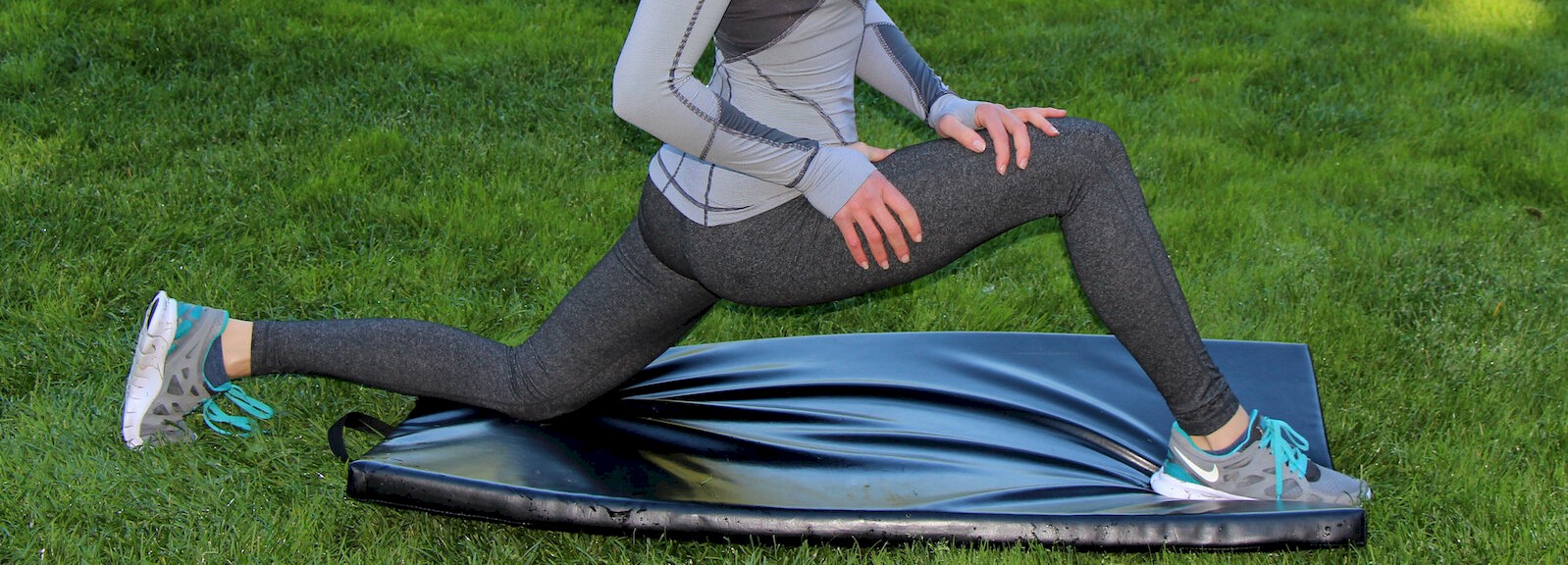
The Lunge
- Start in an upright position with your feet together
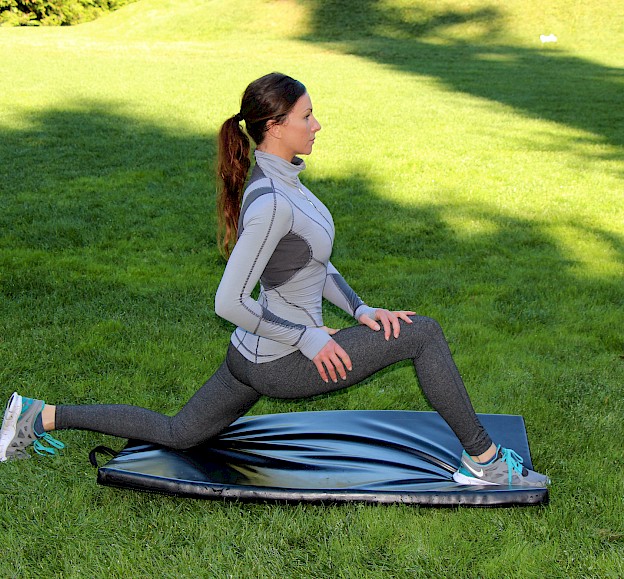
- Step forward with one leg (lunge) – keep the back knee off the floor and the front knee behind the toe. Return to the upright position and then repeat with the other leg.
NB: To increase difficulty, add a backward lunge and/or bags of groceries in each hand. I like to do it with a half-full backpack held to my chest.

Calf Raise
For this one you will need a step and something to hold onto.
- Stand upright on the balls of your feet.
- Lower your heels to the floor and then rise back up onto your toes. For an extra work out try it one foot at a time – do as many as you can on each foot for 30 seconds.
NB: to really increase the difficulty, try doing it without holding onto anything and with a couple of shopping bags of food in your hands on by holding onto a half-full backpack on your chest.

Balance Board Squat
This one can be skipped if you have not had a chance to make your balance board; however, I definitely recommend making one as it really helps your balance and will help to start strengthening your core muscles.
- Start with your feet shoulder width apart on the board.
- Flex your knees a little with your head up so you can start balancing.
- Squat down to a 90 degree angle keeping your knees apart like a cowboy.
- Keep your back in a comfortable non-rounded position
- Rise back up whilst balancing on the board.
NB: to make things a little more difficult try squatting down and grabbing different parts of the board with each hand. (Watch out you don’t squash your hands!)

Quad Stretch
- In a standing position lift one of your feet until you can grab your ankle.
- Point your knee to the ground and pull your foot towards your butt.
- Stretch until the front of your leg muscle (quad) feels tight.
- Hold for 20-30 seconds and repeat on the other leg.

Hamstring Stretch
- Sit down on the floor with your legs straight and apart making a V.
- Reach towards one of your feet with both hands.
- Stretch until you feel the back of your upper leg tighten. Keep your knee flat to the floor and let your back relax by breathing.
- Hold for 20-30 seconds and repeat on the other leg.

Groin Stretch
- Whilst sitting on the floor place your legs wide apart.
- Reach forward whilst pushing your knees apart and down towards the floor.
- Breath and relax whilst holding for 20-30 seconds.

Gluteus Stretch
- With one leg straight cross the other leg over at the knee
- Take your opposite elbow and to bent leg and twist your body in the same direction
- Keep your butt on the ground, use your back hand for balance and look behind you
- Hold for 20-30 seconds and repeat on the other leg

Upper Body
Push Up's
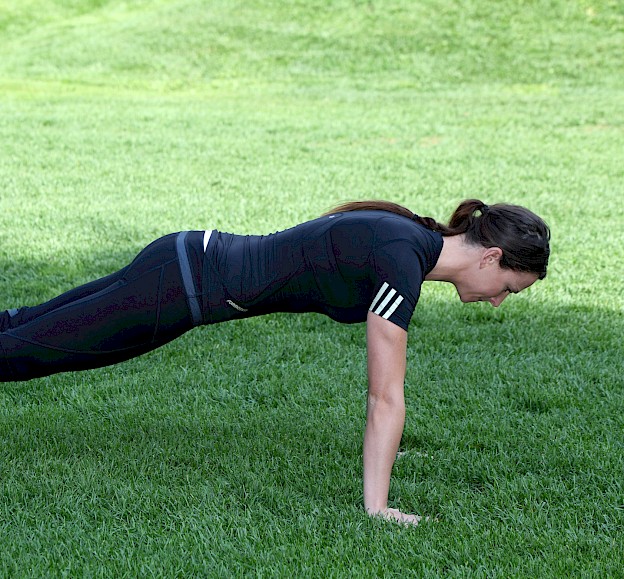
This exercise works the chest, shoulder, triceps and wrist/ forearm area. Like the dip, a great exercise for beginners (getting up after catching a toe side edge) but equally important for injury prevention at all levels. A strong shoulder complex can be the difference between a sore shoulder and a dislocation. For advanced try the balance board version. A lot tougher.
This is a great exercise for building shoulder, chest, triceps and wrist areas. These are all important areas for both the beginner (for getting up) and the pro (to handle the big falls). Building up strong shoulders really makes the difference when you have those big falls.
You can do this exercise on the ground or to build stabilizing muscles try it on a balance board.
- Place your hands shoulder width apart.
- Whilst keeping a straight back, lower your chest to the ground and breathe in
- Without touching the ground with your chest, push back to the starting position.

Dips
Like the push up it works the chest, shoulder, triceps and wrist/ forearm area. It works the shoulders to build them up to handle big impacts and is great for beginners who need to get up onto their heel side edge.
- In sitting position place hands on balance board.
- Lower the body by bending shoulders and elbows. 45 - 90 degrees elbow flexion
- Raise body by extending shoulder and elbow.

Dumbbell Rows
To develop upper-body symmetry and stability you need to do two things; you need to push and you need to pull. The dumbbell row is one of the best when it comes to working the back (pulling muscles). Not only does it strengthen the specific muscles (Latissimus dorsi, trapezius and quadratus) but stretches them as well. Because the rider uses these same muscles in a rotative way, the variation I have included involves a little more rotation. The rider will benefit from increased neck stability (trapezius) and overall injury prevention.
The dumbbell row works well as it both strengthens and helps to stretch the muscles. The main muscles it works are the trapezius (down your side). You will want to do this exercise to develop upper body symmetry and stability.
- With dumbbell in right hand place left knee and hand on flat bench.
- Bend at waist and maintain a straight upper back.
- With palm facing body, pull dumbbell up even with lower chest.
- Lower weight to bottom position and repeat.

Shoulder Stretch
The shoulder stretch focuses on the rotator cuff and the back of the shoulder. Keeping your shoulders flexible is key as when you are winding down the windows whilst trying to stay balanced. You want to be able to move quickly and not be restricted.
- Whilst standing grab the left wrist with your right hand
- Pull your left wrist across your body and stretch your shoulder until it feels tight. Hold for 20-30 seconds.
- Repeat on the other side.

Overhead Shoulder Stretch
The overhead shoulder stretch focuses on keeping the shoulder flexible in overhead movements and stretches the large upper back muscles. Again like the shoulder stretch, this helps to keep your arms from being restricted by your muscles so you can adjust your arms for balance.
- Whilst standing grab your right elbow with your left hand behind your head.
- Pull your right elbow behind your head and stretch until it feels tight. Hold for 20-30 seconds
- Repeat on the other side.

Exercises for your Core
Knee Side Roll
This is a great torso strengthener. Instead of the standard upper body rotation the lower body is rotated. This can be achieved by stabilizing the lower body with weights or by using a strong stretch across your chest. The muscles being used are internal and external pbliques, quadratus lumborum and upper body stabilizers. You will really notice a difference this exercise makes to your bent knee spinning, control and landings.
- Lye on your back and bend your knees to a 90 degree flexion.
- Stabilize your upper body by holding your straight arms out to your sides away from your body.
- Rotate your knees down to the floor on your left and then on your right.
- To take it to the next level try it with your legs slightly straightened.

Side Crunches
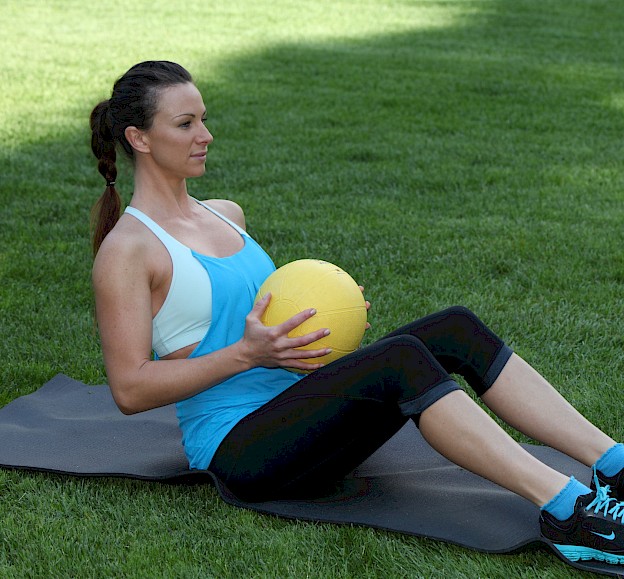
The side crunch is similar to the ab crunch which everybody knows. It is used to strengthen the mid section of the body. The muscles being worked are the internal and external obliques which help rotate the body to the left and the right. These muscles assist in spine stabilization which will give you better balance, stronger spinning and improved overall performance.
- Lie on your back and bend your knees to 90 degrees. Place your hands clasped behind your neck.
- ift and rotate the left side of your body slightly to the right.
- Lower and repeat to the opposite side

Reverse Side Crunch
The reverse side crunch is a great one as it creates a muscle 'belt' to help support the spine from the inside out. This exercise will help strengthen most of the muscles in your upper and lower back through a rotative exercise. This will help you stay stable in choppy conditions and solid when landing those big tricks. It is great for building strength to use for initiating big spins.
- Lye on your front and clasp your hands behind your head.
- Raise your left side up with the left elbow and keep the right elbow on the floor
- Lower yourself down and raise the opposite side.

Side Plank
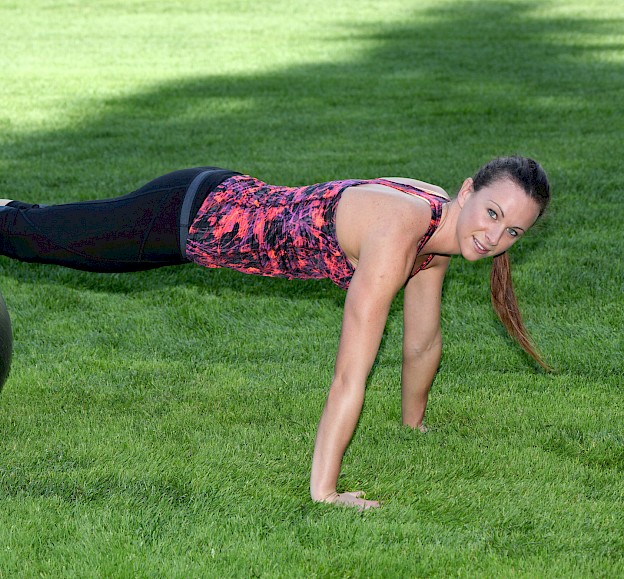
The side plank can be a static exercise for strengthening the abdominal's, back and shoulders. Isometric strength is important for stabilizing the trunk. The abdominal plank is a great exercise for strengthening the transverse abdominus. The transverse abdominus is the deepest layer of abdominal muscle and wraps around the whole midsection. When you contract the abdominals, your waist becomes thinner. This is the action of the transverse. Therefore, a strong transverse abdominus means a smaller, tighter waist. When you are doing the plank exercise or a variation of the plank, make sure to contract your abdominals while remembering to breath. A static plank involves moving to the starting position in the first picture and holding for 1 minute. We are going to step it up and make it dynamic.
- Lift your body off the ground with one arm and stretch your other arm to the ceiling.
- Hold this positing with your back straight.
- Slowly lift your top leg toward the roof and then lower whilst keeping your core tight.
- Repeat for 30 seconds and then switch sides.

Cat Stretch
The cat stretch feels great on your lower back and can be used for relaxation. Think about breathing in whilst arcing your back and then breathing out as you lift your head.
- Start in a kneeling position, head down and back rounded.
- Lift your head, arch your back and breath out
- Move mack to the original position slowly and repeat 10 times.

Clock Face Stretch
The clock face is another great lower back stretch to help loosen up all the tension which builds from riding or lifting weights. It will keep you flexible and uses the weight of your rotating arm to apply the stretch. When doing this exercise the goal is to rotate the upper arm around in a circular motion with your arm stopping at each 3 hour mark.
- Lye on your side with your arms extend out in from t of you and your right leg 90 degrees to your body
- Rotate your upper arm to 12 o'clock and then breathe
- Rotate your arm behind you to 9 o'clock and then breathe
- Continue the rotation around the body 3 times and then switch to the other side and repeat.

Piriformis Stretch
The piriformis stretch works on stretching the lateral rotators of the hip. Anyone who has ever had trouble with pressure on their sciatic nerve will know this stretch. Overly tight piriformis muscles can press against the nerve and cause all sorts of pain in the lower leg and back. These muscles are one of the muscles used the most when ripping it both on snow and initiating spins.
- Lye on your back and clasp your hands behind your head.
- Rest your right foot on your bent left knee
- Slowly lift your left leg up to start the stretch. Stop and hold for 20-50 seconds when your feel the muscle tighten.
- Lower your left leg to the floor and repeat for 10 reps
- Switch legs and repeat.

There are way more exercises which you can use for snowboarding . The best thing to do is visit your local gym and I am sure they will be able to point you in the right direction. Try to ask them for exercises which you can do at the gym and at home this way you can do them when you are just hanging out.
Have fun.